
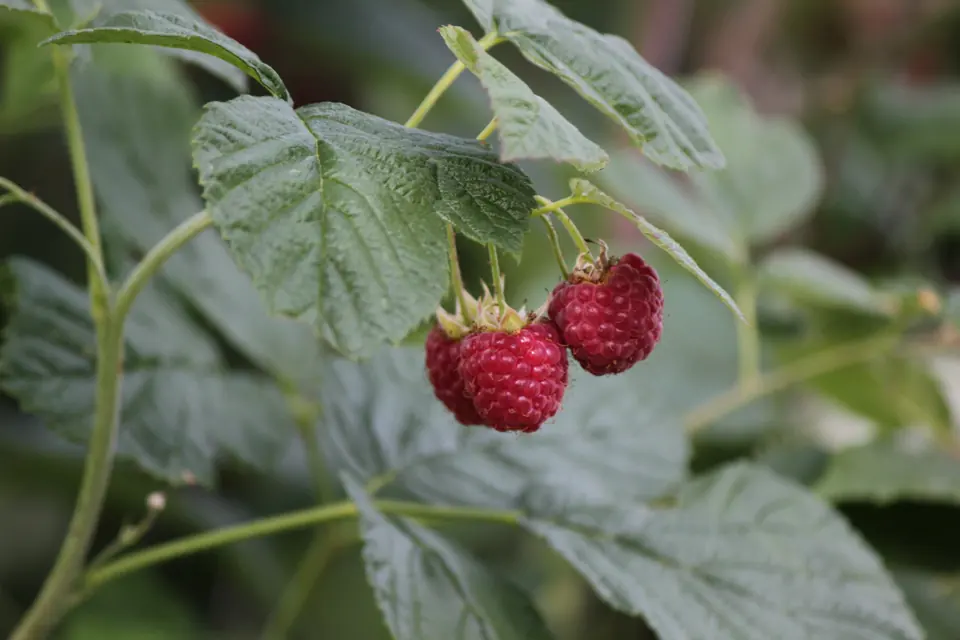
Photo: Robert & Mihaela Vicol, Public domain

The fruit
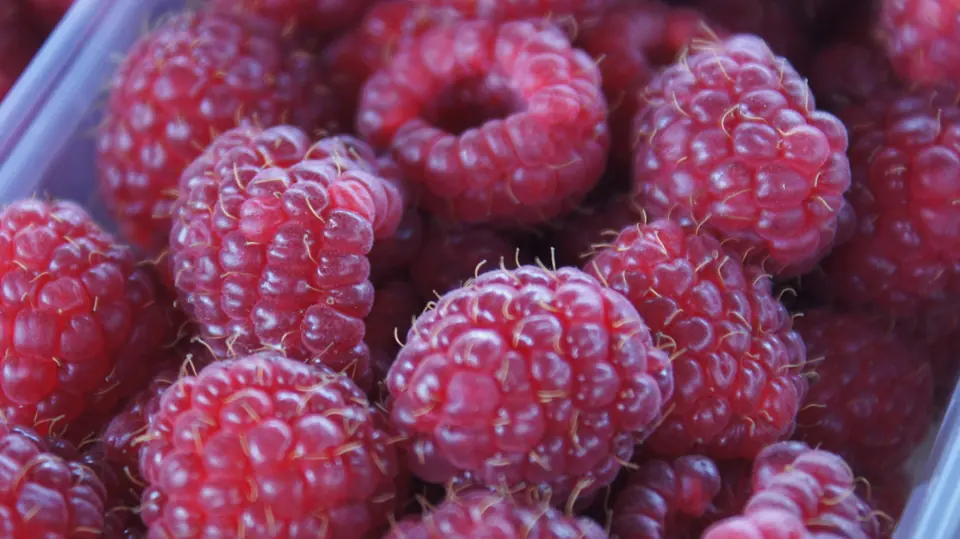
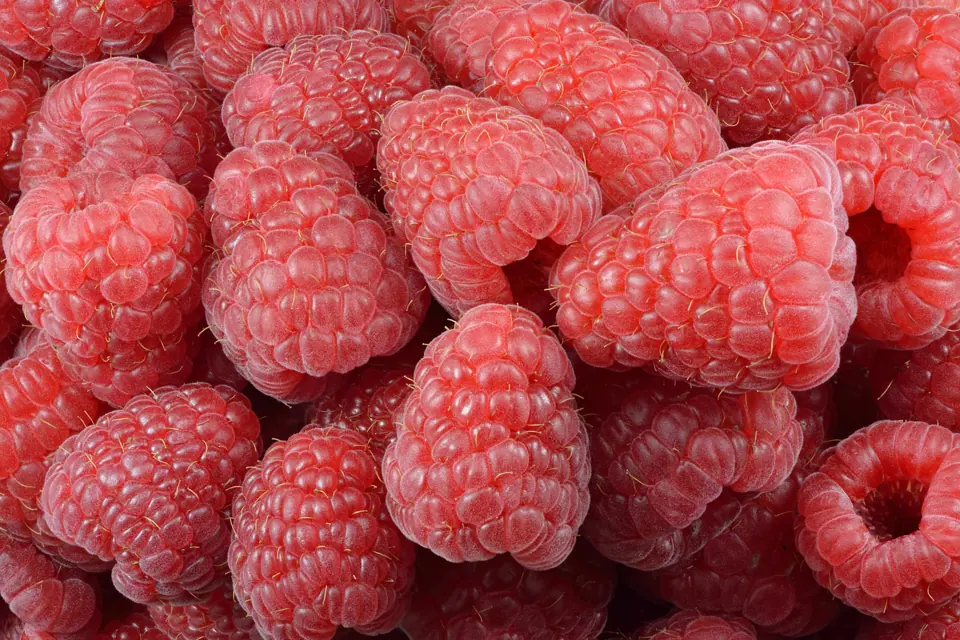
Raspberries
Picked ripe and moved fast: from Spain, Portugal and Morocco for Europe and the Middle East, and from Mexico for North America.
RipeArc supplies fresh raspberries from Spain, Portugal, Morocco and Mexico. Morocco and Spain carry the European winter from October to June, Portugal runs through the summer, and Mexico supplies North America all year with a summer low.
- Origins
- Spain, Portugal, Morocco, Mexico
- Main months
- October to June in Europe; Portugal May to August; Mexico year-round
- Storage
- 0 °C, 90–95% humidity, 2 to 5 days
- Transport
- Truck from Morocco; air over longer distances





When each origin ships
| Jan | Feb | Mar | Apr | May | Jun | Jul | Aug | Sep | Oct | Nov | Dec | |
|---|---|---|---|---|---|---|---|---|---|---|---|---|
| Spain | In season | In season | In season | Peak | Peak | In season | Out of season | Out of season | Out of season | In season | In season | In season |
| Portugal | Out of season | Out of season | In season | In season | Peak | Peak | Peak | Peak | In season | In season | Out of season | Out of season |
| Morocco | In season | In season | In season | Peak | In season | Out of season | Out of season | Out of season | Out of season | In season | In season | In season |
| Mexico | In season | In season | In season | In season | In season | In season | Out of season | Out of season | Out of season | In season | In season | In season |
PeakIn seasonWindows are approximate and move by a few weeks with each season’s weather. Sources are listed at the end of the page.
The four origins
Spain
Spain exported 54,400 tonnes of fresh raspberries worth EUR 516 million in 2025. Exports peak in April and May, at 8,900 and 9,500 tonnes, and fall to about 1,100 tonnes a month from July to September before the autumn crop restarts in October. Almost all of it grows in Huelva, which produced 39,545 tonnes in 2025-26 on 1,924 hectares; the autumn harvest there peaks between November and early December. The main markets are Germany, the United Kingdom and the Netherlands.
Portugal
Portugal exported 30,958 tonnes worth EUR 267 million in 2025, peaking from May to August at 3,900 to 4,500 tonnes a month. Portugal Fresh says it is the only European country able to produce raspberries 52 weeks a year. About 96% goes to the EU, led by Spain, France, the Netherlands and Germany. The planted area, 1,564 hectares, practically doubled between 2020 and 2024.
Morocco
Morocco is the largest supplier to Europe from outside the EU: 64,400 tonnes worth USD 487 million in the July 2024 to June 2025 season, with the United Kingdom, Spain, the Netherlands, Germany and France taking 94% of it. EU imports from Morocco run from October to May and peak in April; in July and August practically nothing arrives. In 2025 Morocco supplied about 97% of the EU’s fresh raspberry imports from outside the EU, and 63% of the UK’s. Its fruit reaches Europe by truck.
Mexico
Mexico is the largest grower: about 180,000 tonnes in 2025 and a forecast 194,000 tonnes in 2026, around 80% of it exported, mainly to the United States. Jalisco grows 67%, Michoacán 19% and Baja California 10%. Production runs all year with a summer low, and takes over from California’s Watsonville season, which runs to November. Very little goes to Europe: 181 tonnes in 2025.
The varieties
Almost every commercial raspberry is a proprietary variety grown under licence. Two terms matter when you read a supply programme: a floricane crop is borne on last year’s cane in summer, a primocane crop on this year’s cane in autumn, and some varieties bear both. These are the varieties behind our origins.
| Variety | Breeder | Crop | What it offers | Where it is grown |
|---|---|---|---|---|
| Adelita | Planasa, Spain | Primocane: October to December, then late April to early June | Medium red, glossy, firm; holds quality and colour for 48 hours at about 2 °C; leads the winter segment since 2012 | Spain, Portugal, Morocco, Mexico (Baja California) |
| Pink Hudson | Planasa | Primocane | Complements Adelita and extends the season by almost two months; early October to mid-June in Morocco | Morocco |
| Lupita | Planasa | Primocane: same windows as Adelita | Light red, smaller than Adelita | Spain and its licensees |
| Maravilla | Driscoll’s | Primocane and floricane | Large fruit, consistent in size and shape, high yield | Mexico; one of the two varieties Mexican growers focus on in 2026 |
| Enrosadira | Proprietary | Chosen by Mexican growers for bigger size, sweeter flavour and longer shelf life | Mexico | |
| Kwanza | Advanced Berry Breeding, Netherlands | Late primocane | Very large, light red; suited to substrate and to double cropping, autumn and spring | European programmes |
| Glen Lyon, Glen Ample | James Hutton Institute, Scotland | Hutton calls Glen Ample the number one variety in the UK and Glen Lyon the number one in Spain (undated) | UK, Spain |
Quality standards
Raspberries fall under UNECE standard FFV-57 for berry fruits (2023 edition), with three classes: Extra, Class I and Class II. In every class the berries must be intact, sound, clean, practically free from pests, fresh in appearance, free of abnormal moisture and of foreign smell or taste, and able to withstand transport; they must be ripe but not overripe. There is no sizing. Class I allows very slight juice leakage and bruising. Tolerances are 5% for Extra, 10% for Class I with at most 2% below Class II or decayed, and 10% for Class II with at most 4% decayed. In Extra and Class I the berries in a pack must be practically uniform in ripeness. European buyers typically ask for Class I; Class II may be accepted for organic fruit.
The EU has no raspberry-specific marketing standard, so the general standard applies, and fruit that meets the UNECE standard is taken to meet it. The United States has a voluntary grade standard from 2016: U.S. No. 1 allows 10% defects by volume, with at most 1% mould or decay. Buyers judge ripeness by surface colour, and a raspberry does not improve after picking. Industry experts quoted by CBI expect an average of at least 4 g per berry. Retail packs run from 125 to 425 g; 125 to 150 g is the most common because of the short shelf life. GLOBALG.A.P. with the SPRING water add-on is the standard certification; UK buyers often ask for SMETA as well. EU contaminant limits are 0.1 mg/kg lead and 0.04 mg/kg cadmium.
Storage and shelf life
Raspberries are the most perishable fruit in our range. Hold them at 0 °C (±0.5) and 90–95% humidity for a storage life of 2 to 5 days; at 20 °C they respire about eight times faster than at 0 °C. Cool promptly, then ship under a modified atmosphere of 15–20% CO2 and 5–10% O2, which slows grey mould (Botrytis), a rot that keeps growing even at 0 °C, and Rhizopus, which stops below 5 °C. Below 2% O2 or above 25% CO2 causes off-flavours and browning. Keep damaged berries out of the pack, because rot spreads to their neighbours. South Africa’s export board recommends cutting to cooling within 60 minutes of harvest. Raspberries do not respond to ethylene.
That window is why raspberries only move long distances by air, and why Morocco’s short truck run to Europe matters. For air shipments the delivery term is CIP, not CIF, which applies only to sea and inland waterways.

Market access by destination
Each importing country sets its own conditions for each origin. This is what applies to our four origins.
| Destination | Spain | Portugal | Morocco | Mexico |
|---|---|---|---|---|
| EU | Free movement | Free movement | Phytosanitary certificate; 0% duty | Phytosanitary certificate; 8.8% third-country duty (preferences not checked) |
| United Kingdom | Phytosanitary certificate and IPAFFS pre-notification; 0% duty for the EU, Morocco and Mexico | |||
| United States | Not verified | Not verified | Continental US ports; permit, inspection and a Monilinia fructigena declaration | All ports; permit and inspection |
| China | Not verified | Not verified | Not verified | Not verified |
| Israel | Permitted; no licence; pest declarations on the certificate | Permitted; no licence; pest declarations on the certificate | Not permitted | Not permitted |
“Not verified” means the official text could not be opened; it does not mean the route is closed. Israel admits raspberries only from a defined list of European countries, duty-free. Full Israeli conditions: Importing into Israel.
- Spain, Portugal, Morocco, Netherlands and EU imports: Eurostat Comext DS-045409, fresh raspberries (CN 0810 20 10), annual and monthly 2024–2025, data updated 16 October 2026. Huelva: FreshPlaza citing Freshuelva, 15 July 2026; FreshPlaza citing the Andalusian price observatory, 6 January 2026. Portugal: ECO/Lusa citing Portugal Fresh, 25 May 2026; Government of Portugal, 10 June 2026.
- Morocco: EastFruit, 4 September 2025; HortiDaily citing EastFruit, 27 August 2026; CBI, raspberries and blackberries market entry, 2 October 2025.
- Mexico: USDA FAS GAIN MX2026-0015, Berry Annual, 11 March 2026; FreshFruitPortal, 28 July 2026.
- Varieties: US plant patents PP25,245 (Adelita), PP25,171 (Lupita), PP14,804 (Maravilla), PP34,070; FreshFruitPortal on Planasa, 19 August 2024; Nourse Farms, Kwanza; James Hutton Institute.
- Standards: UNECE FFV-57 Berry fruits, 2023 edition; Regulation (EU) 2023/2429; USDA AMS, US Standards for Grades of Raspberries, 2016; CBI market entry, 2 October 2025.
- Storage and transit: UC Davis Postharvest Center, bushberries; Freight News citing PPECB, 14 August 2023; CBI market entry and market potential, October 2025.
- Market access: EUR-Lex, Regulation (EU) 2019/2072 consolidated 15 October 2026; EU TARIC and UK Trade Tariff, 29 October 2026; USDA APHIS ACIR, raspberry documents for Mexico (5 March 2025), Morocco (5 March 2025) and other origins; Israel: PPIS, list of fresh produce permitted for import, 10 June 2026, and Yeela import conditions for Rubus idaeus, read 29 October 2026.