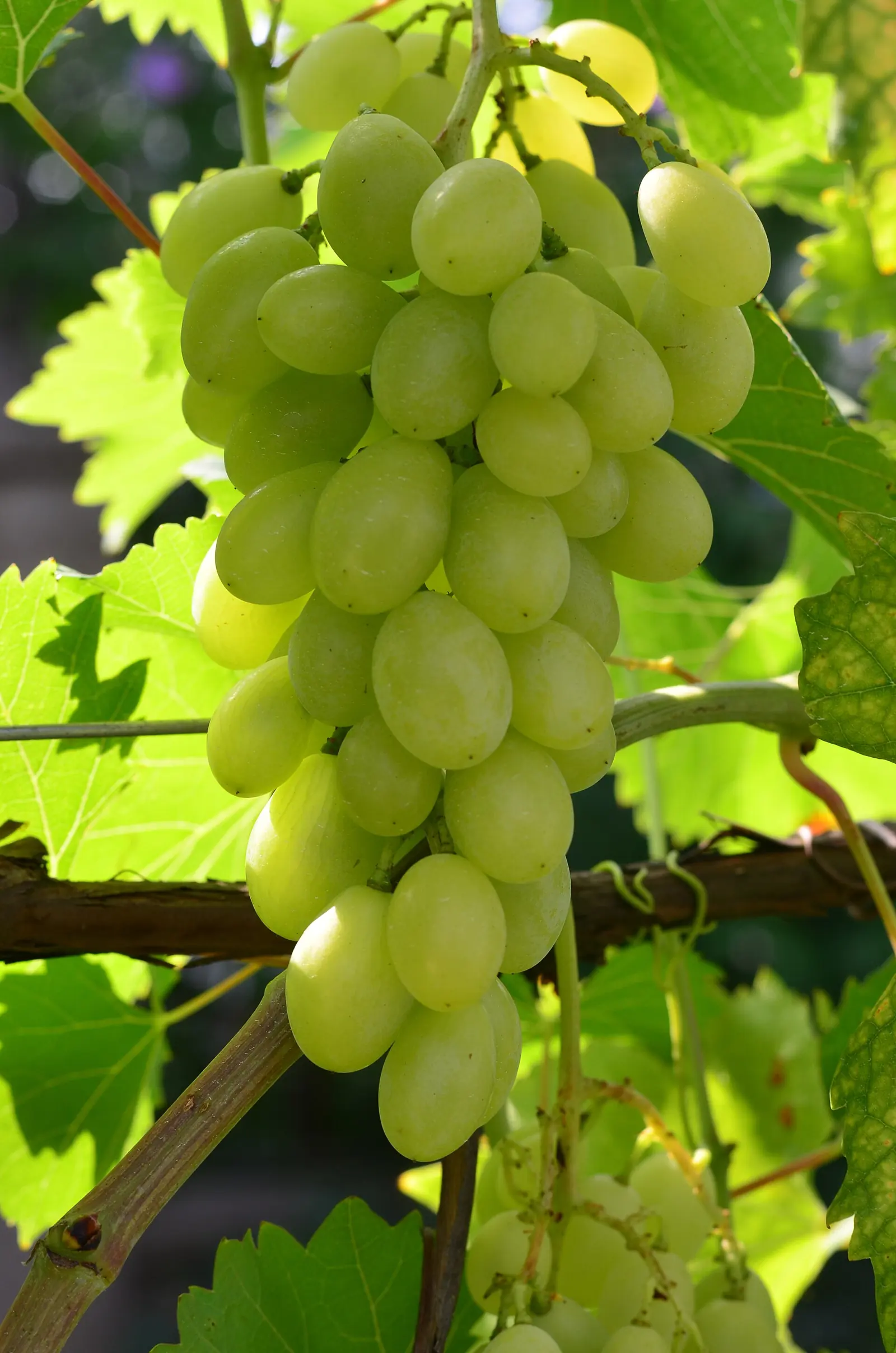
Photo: Oprienko, CC BY-SA 4.0

Seedless grape varieties, from early to late
Ask for “red seedless” and you could get Crimson, Allison or Sweet Celebration. They taste, look and travel differently. Here is how to tell them apart.
The southern hemisphere has moved to licensed seedless varieties. Sweet Globe and Autumncrisp lead the white grapes, Sweet Celebration and Allison are taking over the reds, and Crimson Seedless and Red Globe are declining. Name the variety in the order. Colour, crunch, sweetness and storage life all depend on it.
Why the variety matters more than it used to
Ten years ago a buyer could ask for Thompson, Crimson or Red Globe and know what would arrive. Today 85% of Peru’s grape area and 72% of Chile’s production is licensed varieties, bred by companies such as IFG and Sheehan (both now part of Bloom Fresh) and Sun World. In South Africa, Crimson Seedless is still the largest export variety but has shrunk by 8% a year over four years, while Sweet Globe, Sweet Celebration and Autumncrisp grow by 16–18% a year.
Breeders time their varieties against Thompson Seedless at the same site: “Thompson +2 weeks” means about two weeks later. That is the most reliable way to know where a variety falls in any origin’s season.
White (green) seedless
- Prime. Very early, bred at Israel’s Volcani Center. South Africa exported 6.5 million cartons in 2025-26.
- Ivory. Early, extra-large uniform berries, crisp, sweet and neutral, stores well. Up 21% in South Africa last season.
- Timpson. Mid-season, large to extra large, mild muscat, stores well. Growing fast in South Africa (43% a year) and Chile.
- Sweet Globe. Thompson +2 weeks. Large oval berries of 18–24 mm, honey-sweet with low acidity, extremely crunchy, with a thin skin. The breeder’s optimum is 18–20 °Brix. Peru’s largest variety, at 26% of exports.
- Cotton Candy. Thompson +2 weeks. Tastes of candy floss and toffee, crisp, 18–22 °Brix.
- Autumncrisp. About a month after Thompson. Large, firm, round berries, a crunchy bite and a mild sweet muscat flavour, around 19 °Brix. Peru’s second variety (21%), and the largest in South Africa’s Berg River.
Red seedless
- Sweet Celebration. Same timing as Thompson. Bright red skin that does not darken as sugar rises, oval berries of 21–23 mm, fruity and crisp, 18–21 °Brix. South Africa’s fastest-growing red: 8.6 million cartons in 2025-26.
- Jack’s Salute. Thompson +2 weeks. Elongated berries of 18–23 mm, sweet and neutral, crisp, stores well. One of Chile’s fastest-growing reds.
- Allison. Late. Medium-large berries in large bunches, crisp, sweet and neutral, good storage. Peru (11%) and Chile.
- Scarlotta Seedless. Late, about 30 days after Thompson. Crisp, juicy, large elliptical berries that colour red even in shade, with subtle sweetness and low acidity.
- Crimson Seedless. Late. Firm and crisp with excellent flavour, but colour and berry size can fall short. It is declining in South Africa, and Chilean growers report low prices for it.
- Red Globe. Seeded, not seedless, but still traded in volume: very large round berries, crunchy, with a delicate flavour. 10% of Peru’s exports, down from 48% of its certified area a decade ago.
Black seedless
- Sweet Sapphire. Thompson +1 week. A tubular berry with a dimpled end, high bloom, sweet and neutral, crunchy, stores without shattering. One of Chile’s three largest black varieties.
- Autumn Royal. A late black-to-purple grape bred by the USDA, known for storing well.
Black grapes are a small share of every origin: 4% of Peru’s exports in 2025-26, and about 4.5 million boxes, unchanged, in Chile’s first estimate for 2026-27.
How to use this when buying
- Order by variety, not just colour, and agree a substitute in advance for weeks when your first choice is short.
- Match the variety to the journey. For long voyages and storage, choose varieties the breeder rates for storage, such as Sweet Globe, Allison, Ivory and Timpson.
- Use the timing to plan the season. Early varieties open each origin, and late ones such as Autumncrisp, Allison and Scarlotta close it.
- Specify sugar separately. The breeder’s optimum is not a contract figure. How to specify sweetness.
- Breeders: IFG / Bloom Fresh variety pages; Sun World; Australian Table Grape Association; US plant patents PP20491 (Autumncrisp), PP23125 (Allison), PP14088 (Scarlotta), PP19912 (Timpson), PP23399 (Cotton Candy), IFG 68-175 (Sweet Celebration).
- Bloom Fresh merger: FreshPlaza, 16 August 2023. Prime and Volcani: FreshPlaza, 27 June 2022. Autumn Royal: USDA ARS, 1997. Crimson: UC Cooperative Extension.
- Volumes: SATI, Statistics of Table Grapes in South Africa 2026; AgroPerú citing Provid, 29 April 2026; Agraria.pe citing Provid, 10 August 2026; Portal Frutícola reporting Frutas de Chile, 28 September 2026; Portal Frutícola, 13 December 2024.