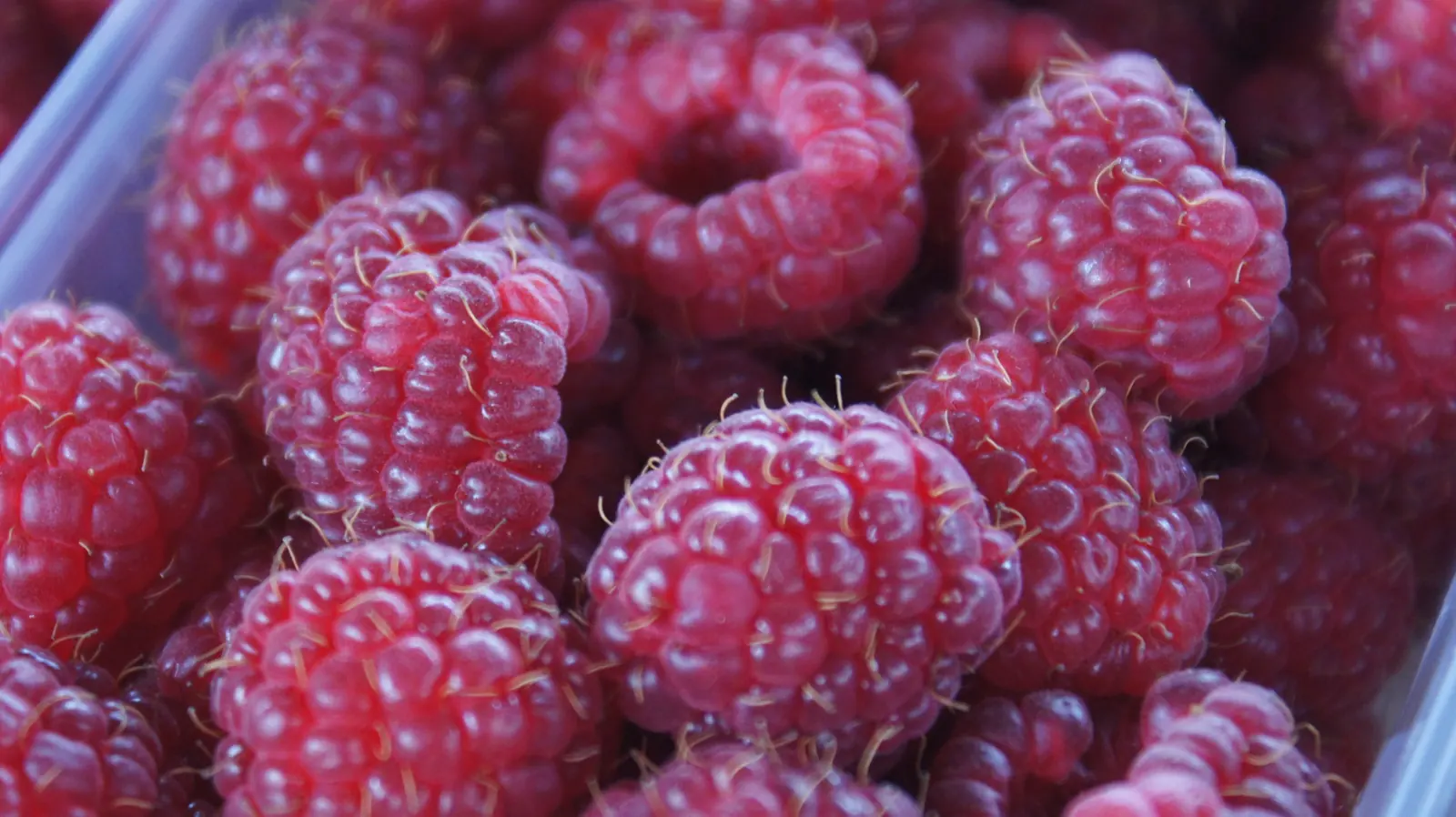

Raspberries from pick to shelf
A raspberry keeps two to five days at 0 °C. How it is packed, graded, moved and checked all follows from that.
Fresh raspberries keep only 2 to 5 days at 0 °C and 90–95% humidity. That is why they cross long distances by air, and why Morocco, Europe’s largest supplier from outside the EU, sends its fruit by truck. A modified atmosphere of 15–20% CO2 slows grey mould, which keeps growing even at 0 °C. On arrival, judge the fruit against a named grade: UNECE Class I, or U.S. No. 1, which allows at most 1% mould or decay.
Why raspberries fly or go by road
The storage life is the whole story. Held at 0 °C (±0.5) and 90–95% relative humidity, a raspberry keeps 2 to 5 days. Warmth uses that time up fast: the fruit respires 12 ml of CO2 per kg per hour at 0 °C, 49 at 10 °C and 100 at 20 °C, about eight times faster at room temperature than in the cold room. Even the breeders count in hours: Planasa’s patent for Adelita, a firm variety, says the fruit holds its quality and colour for 48 hours at about 2 °C.
So the fruit moves by the fastest route its distance allows:
- By road from Morocco. CBI notes that Morocco’s closeness to Europe allows shorter transit times and transport by truck.
- By air over long distances. South Africa’s export inspection board (PPECB) describes raspberries as a fruit that can only be moved long distances by air freight, and fragile in transit. South Africa and Kenya are growing suppliers, mainly to the UK, which CBI says is open to air-freighted produce.
- Not by sea, as far as we can find. We found no published source for fresh raspberries shipped by sea. Chile and Peru, which both grow raspberries, barely export them fresh: Chile’s 2024 crop of 24,875 tonnes went 75% to freezing, 10% to juice and 14% to its home market, with fresh exports of about zero, and Peru’s raspberry trade is concentrated in frozen fruit.
Two practical consequences. Organic raspberries are hard to fly: CBI calls the combination of air freight and organic difficult, and points to land transport from Morocco and Serbia instead. And on air shipments the delivery term is CIP, not CIF, which applies only to sea and inland waterway transport.
Which origin supplies which market
| Origin | Main markets | When |
|---|---|---|
| Morocco | UK, Spain, the Netherlands, Germany and France took 94.4% of its 64,400 tonnes in the 2024-25 season | Mainly October to June; EU imports were practically nil in July and August 2025 |
| Spain (Huelva) | Germany, then the UK and the Netherlands; 54,400 tonnes exported in 2025 | Exports peak in April and May, lowest July to September; the autumn harvest peaks November to early December |
| Portugal | About 96% to the EU: Spain, France, the Netherlands, Germany; 30,958 tonnes exported in 2025 | Exports peak May to August; Portugal Fresh says it can produce 52 weeks a year |
| Mexico | Around 80% of a crop of about 180,000 tonnes (2025) is exported, mainly to the United States | All year, with a summer low; takes over from California’s Watsonville season after November |
| United Kingdom | Home crop of 17 thousand tonnes in 2025 | June to November |
| South Africa, Kenya | Mainly the UK; South Africa by air | Growing in importance, according to CBI |
Morocco is Europe’s main supplier from outside the EU: in 2025 it provided about 97% of the EU’s fresh raspberry imports from third countries, and 62.9% of UK raspberry imports in the 2025-26 marketing year. Mexico sends very little to Europe, 181 tonnes to the EU in 2025. Paperwork follows the border: raspberries entering the EU from any third country except Switzerland need a phytosanitary certificate, the UK asks for one plus an IPAFFS pre-notification, and Mexican raspberries enter the US at all ports with an import permit and inspection. Israel admits fresh raspberries only from a defined list of European countries, Spain and Portugal among them. Origin by origin details and market access: Raspberries.
Modified atmosphere: what the pack is doing
Cooling comes first. PPECB recommends getting raspberries from the field into cooling within 60 minutes of harvest, and the atmosphere should only be modified once the fruit is cold.
The recommended shipping atmosphere is 15 to 20% CO2 and 5 to 10% O2. It reduces grey mould and other decay and slows respiration and softening. Whole-pallet covers and the consumer packs themselves are commonly used to hold it. Go too far and the fruit suffers: below 2% O2 or above 25% CO2 causes off-flavours and brown discolouration.
Ethylene is a lesser concern. Raspberries produce little (0.1 to 1.0 µl/kg per hour at 5 °C) and do not ripen in response to it, though removing ethylene from storage air may reduce disease.
Grey mould and the other rots
Grey mould (Botrytis cinerea) is the main threat because cold does not stop it: it keeps growing at 0 °C, only very slowly. Rhizopus rot, by contrast, does not grow below 5 °C. Rot spreads from a diseased or wounded berry to the berries touching it, which the trade calls nesting, so damaged fruit must stay out of the pack.
The best disease control is the same list every time: cool promptly, store at the lowest safe temperature, avoid physical injury, and ship under high CO2. Two other defects show up without any mould: “leakers”, berries that leak fluid, thought to be a physiological breakdown, and berries that shrivel and lose their gloss as they lose water.
Punnets and packs
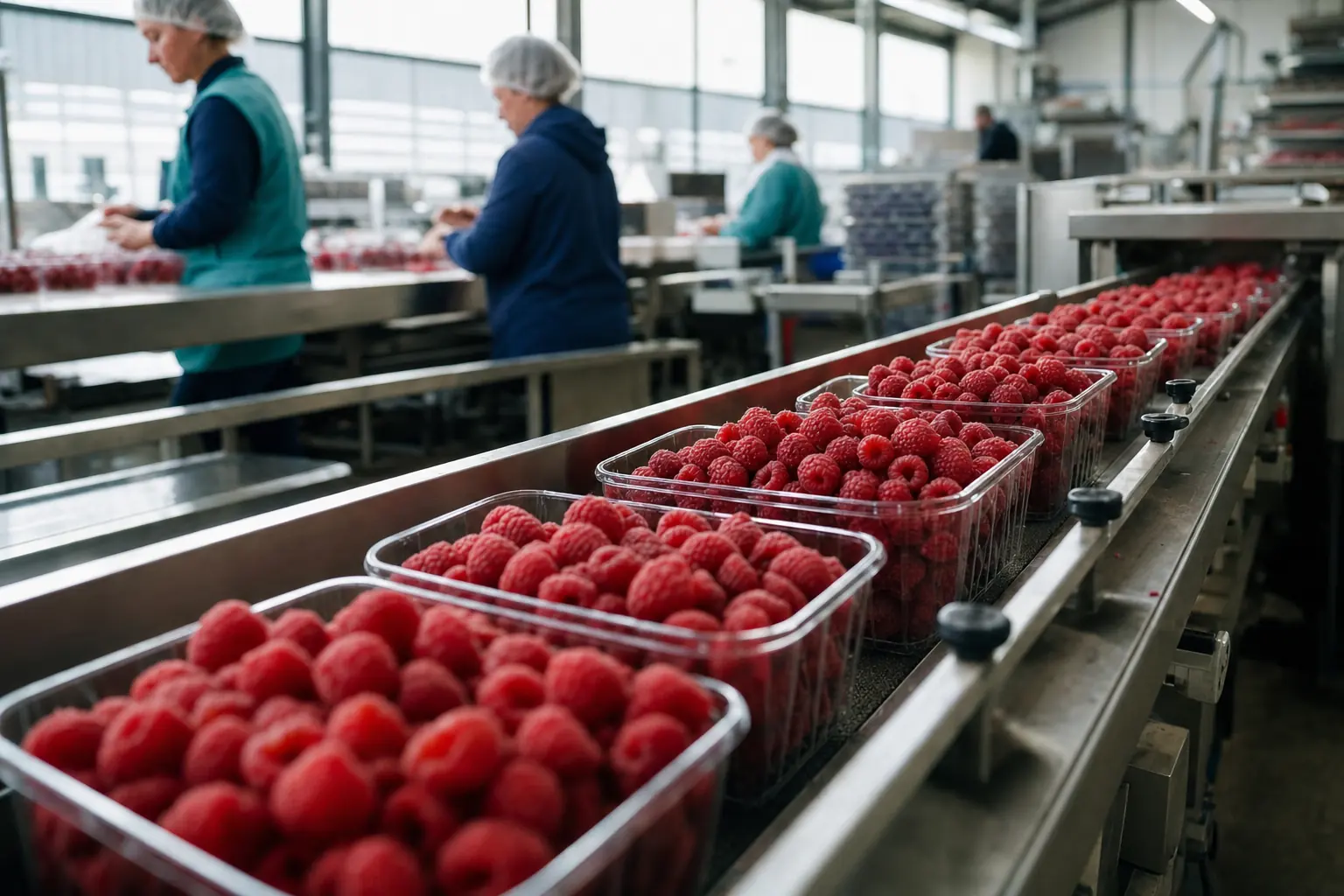
There is no standard pack size. In Europe consumer packs run from 125 g clamshells up to 425 g, and because the shelf life is so short, 125 to 150 g packs are the most common. Under UNECE FFV-57 each package holds one origin, one variety and one quality, and in Extra and Class I the berries must be practically uniform in ripeness. The package must show the packer or dispatcher, the country of origin, and the word “Raspberries” if the contents are not visible; the variety name is optional.
Grades: UNECE FFV-57 and U.S. No. 1
Raspberries fall under UNECE standard FFV-57 for berry fruits (2023 edition). Every class must be intact, sound, clean, practically free from pests, fresh in appearance, free of abnormal moisture and foreign smell or taste, and ripe but not overripe. There is no sizing. The EU has no raspberry-specific marketing standard; fruit meeting the UNECE standard is taken to meet the EU general standard. The United States has a voluntary grade standard from 2016.
| Grade | What it allows | Tolerance |
|---|---|---|
| UNECE Extra | Superior quality; only very slight superficial defects | 5%, of which at most 0.5% of Class II quality |
| UNECE Class I | Good quality; very slight juice leakage and very slight bruising | 10%, of which at most 2% below Class II or decayed |
| UNECE Class II | Meets the minimum requirements; slight juice leakage and slight bruising | 10%, of which at most 4% decayed |
| U.S. No. 1 | One variety; well coloured and developed; not soft, overripe or broken; free from cores, sunscald, mould and decay | 10% by volume, of which at most 5% serious damage and at most 1% mould or decay |
| U.S. No. 2 | Lower grade | At most 10% seriously damaged, of which at most 2% mould or decay |
European buyers typically ask for at least Class I, according to CBI; Class II may be accepted for organic fruit. Industry experts quoted by CBI expect good raspberries to average at least 4 g a berry. Ripeness is judged mainly by surface colour, and eating quality does not improve after harvest, so what is picked is what arrives.
What to check on arrival
- Temperature first. Check the temperature record for the trip and take pulp temperatures; the target is 0 °C (±0.5). Check that the truck or container seal is intact and matches the documents.
- Count the mould. Open punnets from across the load and count berries with grey mould. Under U.S. No. 1 the limit is 1% mould or decay; under UNECE Class I, 2% below Class II or decayed. Look for nests: mould in one berry with the ones around it softening.
- Look for leakers and shrivel. Leaking berries, and dull, shrivelled berries that have lost water, both count against the grade.
- Check colour and uniformity. In Extra and Class I the berries in a pack should be practically uniform in ripeness, and none overripe.
- Weigh a sample if the contract sets a berry size, for example an average of 4 g.
- Read the label: packer, country of origin, and one origin, variety and quality per package.
- Get it back into the cold. Every hour on the dock costs shelf life.
For how many boxes to open and what an inspection report should contain, see Arrival inspection; for how other fruit moves by sea and air, Transit times.
- Storage, atmosphere and rots: UC Davis Postharvest Research and Extension Center, Bushberry produce fact sheet (Mitcham, Crisosto and Kader), last updated August 1998; US Plant Patent PP25,245 (Adelita), 27 January 2015.
- Air freight and cooling: Freight News citing PPECB and the Cool Chain Association, 14 August 2023.
- Transport, packs and buyer requirements: CBI, raspberries and blackberries market entry, 2 October 2025, and market potential, 1 October 2025.
- Grades: UNECE FFV-57 Berry fruits, 2023 edition, issued 15 March 2024; USDA AMS, US Standards for Grades of Raspberries, effective 6 September 2016; Regulation (EU) 2023/2429.
- Origins and markets: Eurostat Comext DS-045409, fresh raspberries, 2024–2025, data updated 16 October 2026; Morocco: EastFruit, 4 September 2025, and HortiDaily citing EastFruit, 27 August 2026; Spain: Freshuelva, via FreshPlaza, 15 July 2026, and the Andalusian price observatory, via FreshPlaza, 6 January 2026; Portugal Fresh, via ECO/Lusa, 25 May 2026.
- Mexico: USDA FAS GAIN MX2026-0015, Berry Annual, 11 March 2026; Agronometrics and USDA Market News data, via FreshFruitPortal, 28 July 2026. United Kingdom: Defra, Horticulture statistics 2025, 25 June 2026. Chile: ODEPA data presented by the International Raspberry Organization, Lima, May 2025. Peru: Agromercado (Midagri), via Italian Berry, 25 February 2026.
- Market access: EUR-Lex, Regulation (EU) 2019/2072, consolidated 15 October 2026; UK Trade Tariff, 29 October 2026; USDA APHIS ACIR, “Raspberry (Fruit) from Mexico into All Ports”, 5 March 2025; Israel: PPIS, list of fresh produce permitted for import, 10 June 2026.