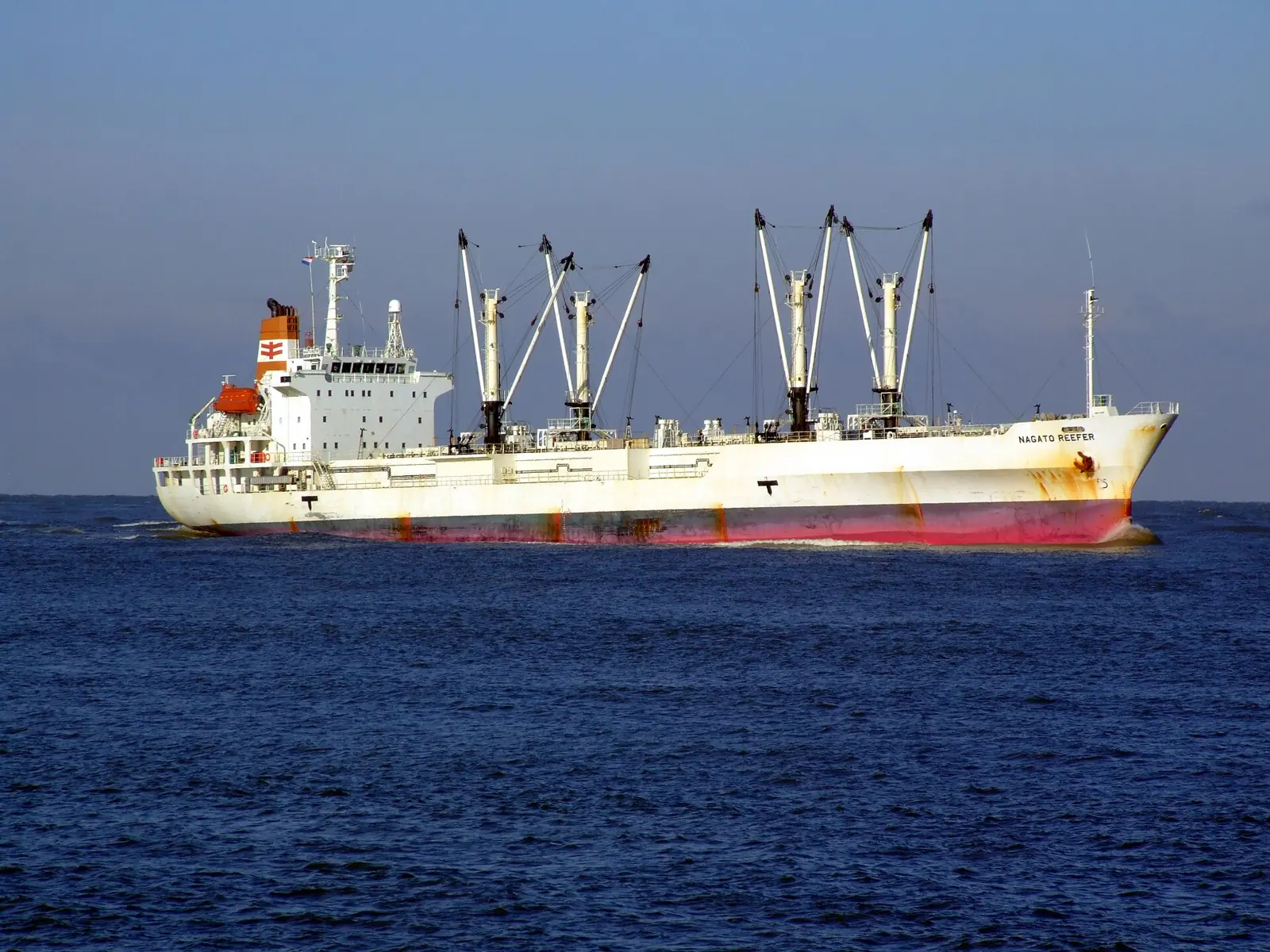
Photo: Alf van Beem, CC0

How long the fruit takes, and why it goes by sea or air
Grapes cross oceans in reefer containers. Most blueberries do too, but not all. Here is how many days each lane takes, and what that leaves for the shelf.
From Peru, Chile and South Africa, fruit reaches Rotterdam in about 18 to 24 days by sea and the US East Coast in about 12 to 14. Grapes almost always go by sea. Blueberries go by sea from Peru and Chile, but by air from Argentina. Where a market requires cold treatment in transit, that sets the shortest possible journey.
Sea transit, lane by lane
| From | To | Days at sea | Service |
|---|---|---|---|
| Paita, Peru | Rotterdam | 18 | MSC, direct, from 2024 |
| Pisco, Peru | Rotterdam / Philadelphia | 20 / 12 | Average transits, USDA 2025 |
| Paita, Peru | Philadelphia | 14 | MSC, via Panama |
| Valparaíso, Chile | Philadelphia area | 12 | Conventional reefer vessels, 2025-26 average |
| San Antonio, Chile | Shanghai / Nansha (Hong Kong) | 23 / 21 | CMA CGM 2025 / Maersk 2024, express services |
| Gqeberha, South Africa | Rotterdam / London Gateway | 21 / 22 | MSC, direct, weekly, from 2025 |
| Cape Town, South Africa | London Gateway | 22 | MSC seasonal service, January 2026 |
| Valencia, Spain | Ashdod / Haifa | 9 / 10 | ZIM, direct, weekly |
| Ravenna, Italy | Ashdod / Haifa | 5 / 6 | ZIM, direct, weekly |
These are port-to-port days. Add packing, inland transport, port time and customs at each end. We found no published direct reefer service from South America or South Africa into Ashdod or Haifa: that fruit is transshipped, and the total depends on the connection.
Sea or air
- Grapes go by sea. 99.5% of Peru’s grape exports leave by ship.
- Peruvian blueberries mostly go by sea: 96% in 2025-26 and 93% so far in 2026-27.
- Argentine blueberries mostly fly: about 90% of exports.
- Early South African blueberries fly too: 92% went by air up to late July 2024, early in the season.
- Raspberries fly, or truck from Morocco. At 0 °C they keep only 2 to 5 days, so long distances are air only; Morocco’s short run to Europe is by road.
- Pineapples sail. MD2 travels by sea at 7 to 12 °C, usually with the banana trade; Costa Rica’s port of Moín is 12 days from Antwerp. Only the small air-freight varieties, Sugarloaf and Queen Victoria, fly.
What the voyage leaves for the shelf
Table grapes keep well: held at −0.5 to 0 °C pulp with SO2 pads, Thompson and Flame Seedless are marketed up to 8 to 10 weeks after harvest. A three-week voyage leaves plenty of time.
Blueberries are tighter. In normal air at −0.5 to 0 °C, highbush blueberries keep for about two weeks; in controlled atmosphere, up to six. A 20-day sea voyage plus port and inland time can use about half of that before the fruit reaches a store. That is why controlled-atmosphere containers and an unbroken cold chain matter so much for sea-freighted berries.
Cold treatment and the timeline, by market
Some markets require fruit to be held cold for a set number of days to kill pests, and the voyage has to cover it:
- United States: Peruvian and South African grapes are cold-treated; Chilean grapes are fumigated with methyl bromide instead.
- China: Peruvian blueberries, 15 days at 1.11 °C, 17 days at 1.67 °C or 22 days below 2 °C. Argentine grapes, 16 days at 1 °C or 21 days at 2.1 °C.
- Israel: South African grapes at least 22 days at −0.55 °C in transit, so 22 days is the shortest possible journey. Peruvian grapes 15 or 17 days in transit, which any Peru sailing covers. Peruvian blueberries need the same 15 or 17 days, listed by PPIS “prior to dispatch”; if it cannot be done in transit, it adds more than two weeks. Chilean and Argentine blueberries are fumigated instead, a matter of hours.
Practical points
- Plan the arrival week from the packing week plus the full door-to-door time, not the port-to-port days.
- For sea-freighted blueberries, ask for controlled-atmosphere containers and for the harvest date on the documents.
- Ask for the temperature log when the container is opened, and take pulp temperatures on arrival. Arrival inspection.
- MSC, enhanced services from Paita, 2024; MSC Eastern Cape Express, 2025; Agri News on the Western Cape Express, 23 January 2026.
- USDA FAS GAIN PE2025-0027, Peru: Fresh Deciduous Fruit Annual, 2 December 2025.
- Fresh Fruit Portal, 2 December 2025; Container News, 25 September 2025; FreshPlaza, 29 March 2024.
- ZIM, ZIM Reefers Premium Services, Port of Koper, June 2025.
- Blueberry transport mode: Italian Berry citing Proarándanos, 11 May 2026; Portal Frutícola quoting the Argentine Blueberry Committee, 20 January 2026.
- Shelf life: USDA, Agriculture Handbook 66, 2016.
- Cold treatment: USDA APHIS ACIR, read 1 October 2026; Peru–China blueberry and Argentina–China grape protocols; Israel: PPIS notice 9-2025, 20 August 2025; PPIS import conditions for Vaccinium from Peru, Chile, Argentina, Spain and Poland, as published on 5 August 2026; PPIS–South Africa arrangement for table grapes, revision October 2006.