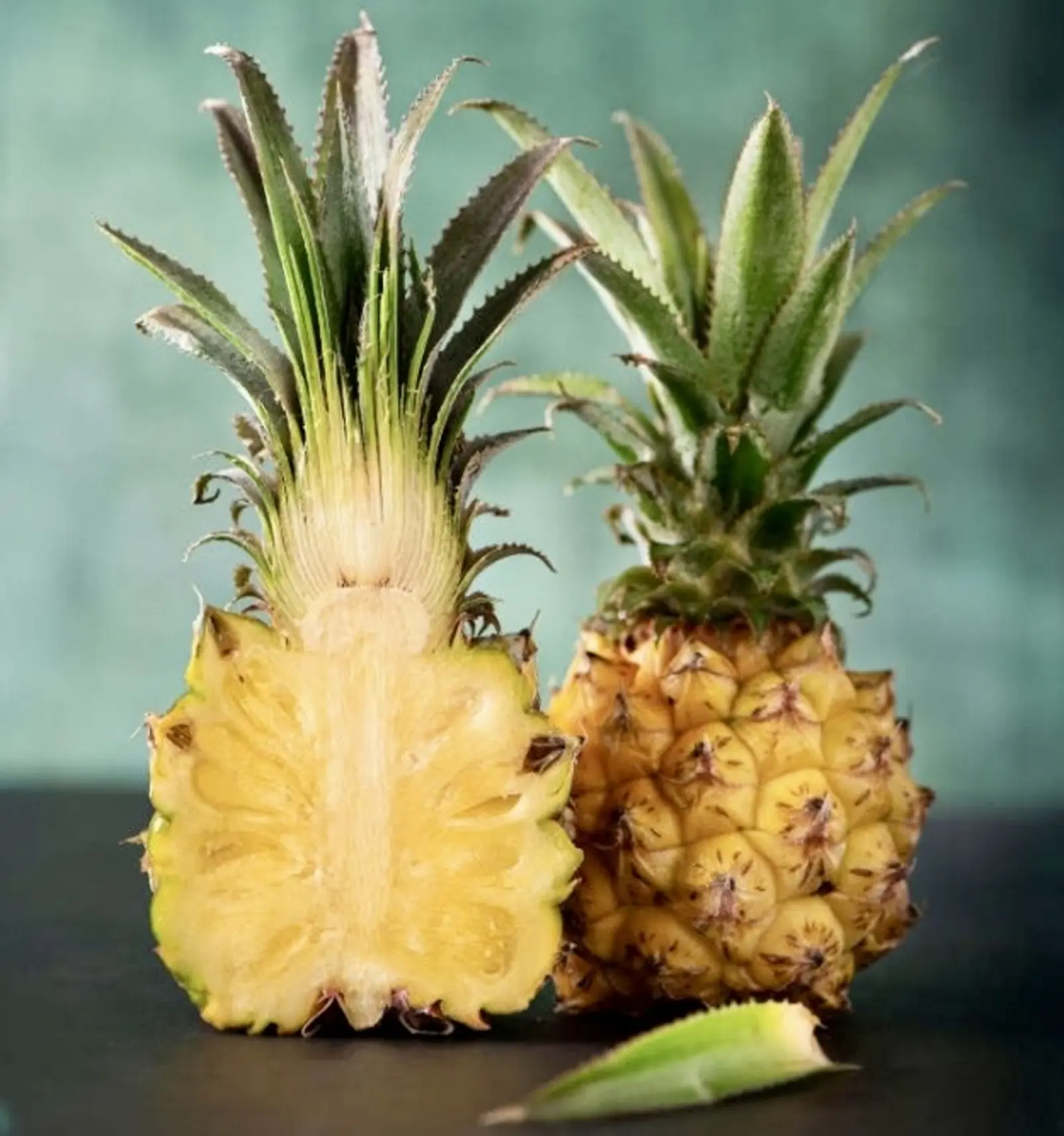
Photo: UneksAbdullahi, CC BY-SA 4.0

Pineapples: ripeness, size and the cold chain
A pineapple does not get sweeter after it is cut. What you buy is what was picked, so the spec, the size code and the reefer setting carry all the weight.
A pineapple is non-climacteric: it does not ripen or sweeten after harvest, so its sweetness is fixed in the field. The Codex standard sets a minimum of 12 °Brix and eight size codes, A to H; the trade buys by count in a 12 kg box, and sizes 6 to 8 are the most wanted. Keep it at 7 to 12 °C. Colder fruit looks fine in the cold room, then shows chilling injury and internal browning once it warms up.
MD2 and the other varieties
Smooth Cayenne dominated production and trade until the mid-1990s, when Del Monte introduced the MD2 hybrid. MD2, also sold as Extra Sweet, now accounts for over 80% of European pineapple imports (CBI, 2022). The ideal Brix ranges below are from CBI’s 2014 product study and describe fruit at its best, not a contract minimum.
| Variety | Ideal Brix (CBI, 2014) | Fruit | How it travels |
|---|---|---|---|
| MD2 (Extra Sweet) | 14.5–16.5% | Cylindrical, flat eyes, yellow to dark-yellow flesh, almost no acidity; thicker skin that resists shocks and bruising; crown usually spineless | Generally sea only |
| Smooth Cayenne | 12.8–14% | Pale-yellow flesh, mixed acid and sugar taste; below the range too acidic, above it too fragile; ripens from the base, so the base is sweeter than the top | Sea or air |
| Queen Victoria | 13.5–16% | Small and trapezoid, prominent eyes, spiny crown, yellow flesh; a “small exotic” | Air only |
| Sugarloaf | 13.5–15% | Bottle-shaped, white to pale-yellow flesh, spineless crown; shell dark green from Ghana, coloured from Benin | Air only |
MD2 ripens from base to top too, but at harvest there is almost no difference in sweetness between the two ends (CBI, 2014). Product details by origin: Pineapples.
Picked ripe, because it will not ripen later
Pineapple produces very little ethylene (0.1 to 1.0 µL/kg per hour) and, in the words of the USDA’s storage handbook (2016), the fruit does “not continue to ripen or sweeten after harvest”. All cultivars therefore have to be harvested ripe. Fruit for sea freight is cut as soon as it is ripe, so it can travel at least 14 days; fruit for air freight is cut as late as possible (CBI, 2014). That is why air-freighted pineapples can be exported at a higher maturity, Brix 15 and above (CBI, 2022).
Immature fruit should not be shipped at all: it never develops good flavour, has low Brix and is more prone to chilling injury (USDA, 2016).
Shell colour can be changed without changing the fruit. Ethephon degreening gives a faster, more uniform colour with little change in quality but a slightly shorter shelf life (USDA, 2016). MD2 responds to half the dose used on Smooth Cayenne; degreening is mainly done on African fruit, while Latin American fruit is hardly degreened and so usually looks less coloured (CBI, 2014). The EU residue limit for ethephon on pineapples is 2.0 mg/kg, and it is banned in organic production (CBI, 2022).
Shell colour stages
Colour is graded on charts. CBI’s 2014 study gives two:
| Stage | Smooth Cayenne chart | MD2 international chart |
|---|---|---|
| C0 | Entirely green | Totally green |
| C1 | One quarter yellow/orange | Most eyes yellow, over 20% of the area |
| C2 | Half | Over 40% |
| C3 | Two thirds | All eyes yellow, over 70% |
| C4 | All over | Over 90%, some green |
| C6 | All eyes 100% yellow, no green |
C0 to C2 is generally recommended for sea transport and C3 to C4 for air freight (CBI, 2014). But a yellow shell is not a sweet pineapple: the USDA handbook (2016) warns that high shell colour “is not always a good measure of sweetness”, and judges maturity by eye flatness as well as skin yellowing. The source’s description of MD2 stage C5 is garbled, so we leave it out.
Look inside too. Translucent flesh is fragile: it is more sensitive to mechanical injury, and soluble solids, flesh colour and palatability peak at about 60% translucency, then decline (USDA, 2016). In MD2, more than 50% translucency signals a short shelf life (CBI, 2014).
Codex classes and the Brix minimum
The Codex standard for pineapples, CXS 182-1993 (amended 2011), applies to fruit sold fresh to consumers. Every class must be whole, sound and clean, free of damage from low or high temperatures and free of internal browning. The fruit must be physiologically ripe: not opaque, flavourless and exceedingly porous (except in varieties such as the Queen group), and not exceedingly translucent or fermented. Total soluble solids in the flesh must be at least 12 °Brix, measured on a juice sample representing all the fruit.
| Class | Skin and shape | Crown, if present | Quality tolerance |
|---|---|---|---|
| Extra | Superior quality; only very slight superficial defects | Simple and straight, no sprouts, 50–150% of fruit length (untrimmed) | 5% meeting Class I |
| Class I | Slight defects in shape and colouring, including sun spots; skin defects up to 4% of the surface, not affecting the pulp | Simple, straight or slightly curved, no sprouts, 50–150% of fruit length (trimmed or untrimmed) | 10% meeting Class II |
| Class II | Defects in shape and colouring; skin defects including bruises up to 8% of the surface | Simple or double, straight or slightly curved, no sprouts | 10% meeting neither class nor the minimum requirements, rotten fruit excluded |
In every class, a crown must be fresh and free of dead or dried leaves, and a stalk, if left on, may be no longer than 2.0 cm, with a straight, clean cut. Crownless fruit is allowed, but the label must say so. Each package holds one origin, variety or commercial type, quality and size; in Extra, colour and ripeness must be uniform too. Buyers in Europe usually go above the Codex floor and target 13 to 17 °Brix, higher for air-freighted fruit (CBI, 2022). In the EU, pineapples have no specific marketing standard and fall under the general standard.
Size codes A to H
Codex sizes pineapples by average fruit weight, with or without the crown, each code ±12%. The minimum is 700 g, except for small varieties such as Victoria and Queen, which may be 250 g. Size tolerance in all classes is 10% of fruit from the size immediately above or below.
| Code | With crown | Without crown |
|---|---|---|
| A | 2,750 g | 2,280 g |
| B | 2,300 g | 1,910 g |
| C | 1,900 g | 1,580 g |
| D | 1,600 g | 1,330 g |
| E | 1,400 g | 1,160 g |
| F | 1,200 g | 1,000 g |
| G | 1,000 g | 830 g |
| H | 800 g | 660 g |
The box: buying by count
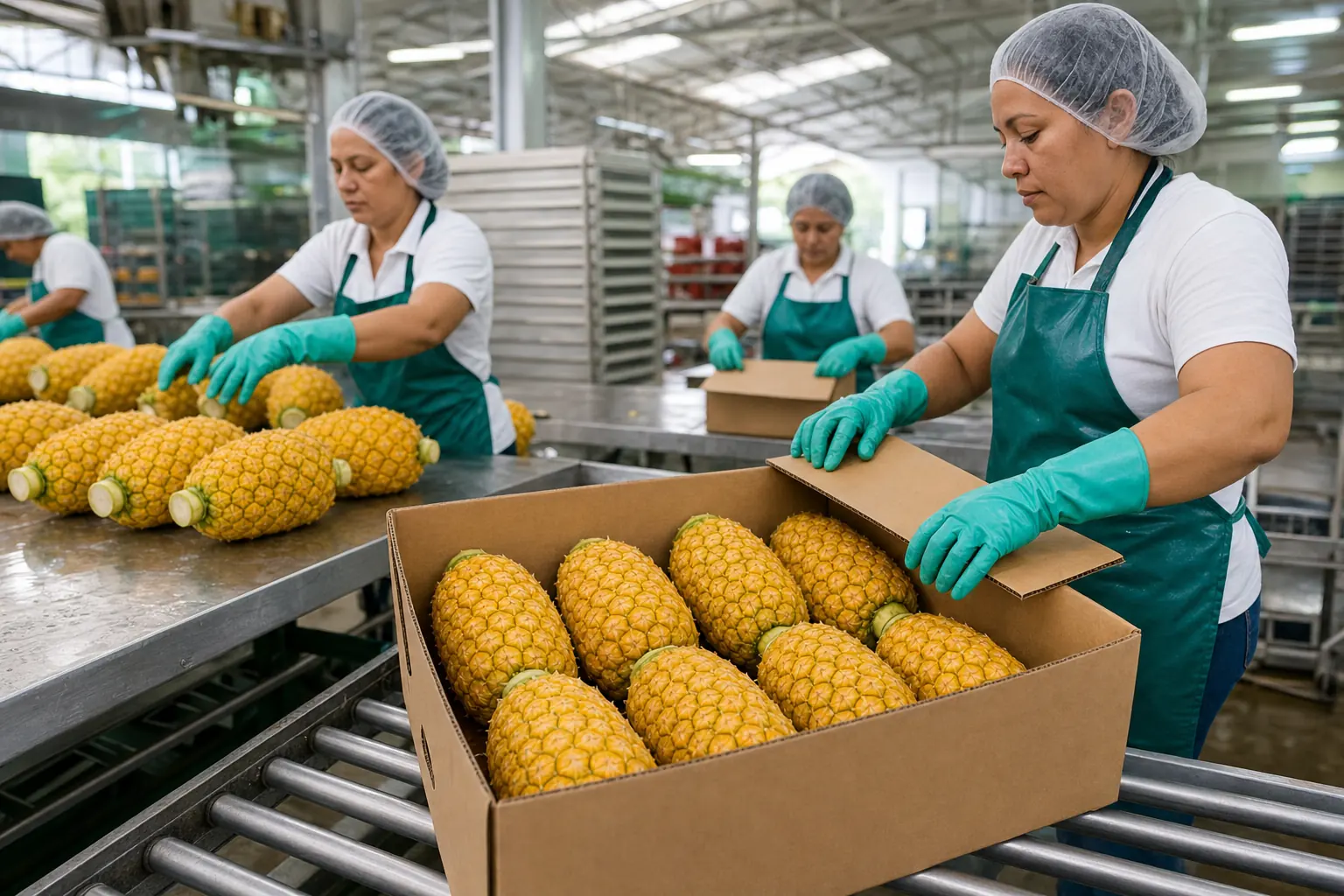
Codex itself notes that much international trade is packed and sold by count per box. The standard pack is an open-top carton of 12 kg gross, about 11.5 kg net, holding 5 to 10 fruit. Sizes 6 to 8 are the most in demand, especially in Western Europe, and supermarkets prefer 7 and 8 (CBI, 2022). Queen Victoria comes in 4 or 5 kg boxes.
CBI’s 2014 study gives the weight band behind each MD2 sea-freight count:
| Size | Fruit per box | Fruit weight |
|---|---|---|
| A6 | 6 | 1,776–2,100 g |
| A7 | 7 | 1,576–1,775 g |
| A8 | 8 | 1,351–1,575 g |
| B9 | 9 | 1,151–1,350 g |
| B10 | 10 | 1,001–1,150 g |
| C12 | 12 | 860–1,000 g |
Removing the crown fits more fruit in a box, and crownless fruit usually earns a higher box price; it makes up an estimated 20 to 25% of the market (CBI, 2022). Buyers expect one origin, variety, quality, size and Brix level in each box, and retailers often want a label on every fruit. Israel, as one example of a market with its own rules, admits fresh pineapple only from Costa Rica, Kenya and the Dominican Republic, and only de-crowned.
The cold chain: 7 to 12 °C, and never colder
Pineapples are chilling-sensitive. The USDA handbook (2016) recommends 7 to 12 °C and 85 to 95% relative humidity, which keeps fruit at the colour-break stage for 14 to 20 days; ripe fruit holds about 7 to 10 days at 7 °C. Reefer settings follow the fruit’s stage: 10 to 12 °C for mature green fruit and 7 to 10 °C for turning fruit, with pre-cooling after harvest (CBI, 2022).
Below that range the damage is hidden until it is too late. CBI’s 2014 study puts the threshold for chilling injury at 4.44 °C or lower. At 0 to 4 °C fruit can be held for weeks, but then fails to ripen and shows severe chilling injury. Even at 7 °C the limit is about four weeks, and chilling-induced internal browning then develops within 2 to 3 days of removal (USDA, 2016).
What chilling injury looks like (USDA, 2016):
- crown leaves that wilt, dry out and discolour;
- green fruit that fails to turn yellow, and yellow fruit that browns and dulls;
- internal browning of the flesh, also called endogenous brown spot or blackheart.
The symptoms appear after the fruit returns to 15 to 30 °C, so a load can pass a cold inspection and fail on the shelf. Controlled atmosphere helps only a little: a tentative recommendation is 2 to 5% O2 and 5 to 10% CO2, and waxing delays chilling-induced browning. Costa Rican fruit is dipped in a wax emulsion containing a fungicide to extend its storage life (CBI, 2014). In the store, whole fruit should be displayed at 10 to 13 °C, not misted or iced.
The main rot is black rot (Chalara paradoxa), which enters through the cut stem or wounds within 8 to 12 hours of harvest. Minimal bruising, refrigeration and postharvest fungicides keep it down (USDA, 2016).
Sea from Costa Rica, air from Africa
Pineapples reach Europe mainly by sea, usually on the same services as bananas (CBI, 2022), and MD2 is generally available only by sea (CBI, 2014). Costa Rica is the origin that matters most: about 60% of world supply by FAO’s estimate, and about 89% of both US and extra-EU pineapple import volume in 2024. From Moín, MSC’s direct service reached Antwerp in 12 days when it launched in 2019, and Hapag-Lloyd’s weekly Caribbean service took about 13, 14 and 16 days to the UK, the Netherlands and Belgium when it started calling at Moín in 2021. We have not checked the current 2026 schedules. For other fruit lanes: Transit times.
The small, very sweet varieties fly. Sugarloaf comes mostly by air from Benin, Ghana, Togo and Cameroon; Queen Victoria from Mauritius and Réunion, and is popular at Christmas and Easter (CBI, 2022). When sweeter, sea-freighted MD2 took the market, Côte d’Ivoire’s Smooth Cayenne exporters moved to air freight; CBI (2022) describes air and sea as two separate markets.
What to check on arrival
- Temperature and the record. Pulp temperatures should be in the 7 to 12 °C band. Any time below 7 °C on the reefer record is a reason to look harder. Check that the container seal is intact and its number matches the documents.
- Crowns and shell. Wilted, dried or discoloured crown leaves and dull, browning shells are signs of chilling. Crowns must be fresh, the right length for the class, and stalks no longer than 2.0 cm.
- Cut a sample. Look for internal browning and for translucency above 50%, and read the Brix on a juice sample: at least 12 °Brix under Codex, or the figure in your contract.
- Hold a few fruit back. If the record shows cold spells, keep a sample at room temperature for two to three days, then cut it; chilling damage shows only after warming.
- Count and weigh. Check the count per box and the weight of each fruit against its size code, and that each box is uniform.
- Skin and stem end. Skin defects up to 4% of the surface in Class I and 8% in Class II; look for black rot at the cut stem.
- Labels. Class, size code or average weight, country of origin, and “crownless” where it applies.
- Codex Alimentarius, Standard for Pineapples, CXS 182-1993, amended 2011.
- CBI, Product characteristics for fresh pineapples (Searce with Thierry Paqui), 2014.
- CBI, pineapples market entry and market potential, last updated 10 October 2022.
- USDA ARS, Agriculture Handbook 66, pineapple chapter (Paull and Chen), February 2016.
- European Commission, marketing standards for fruit and vegetables, read 29 October 2026.
- Supply: FAO preliminary results 2025, via FreshPlaza, 3 February 2026; UN Comtrade, HS 080430, US and EU imports 2024, accessed 29 October 2026.
- Transit: FreshPlaza on MSC’s Moín–Antwerp service, 26 August 2019; APM Terminals Moín, 18 November 2021.
- Israel: PPIS, list of fresh produce permitted for import, 10 June 2026, and Yeela import conditions for Ananas comosus, read 29 October 2026.